
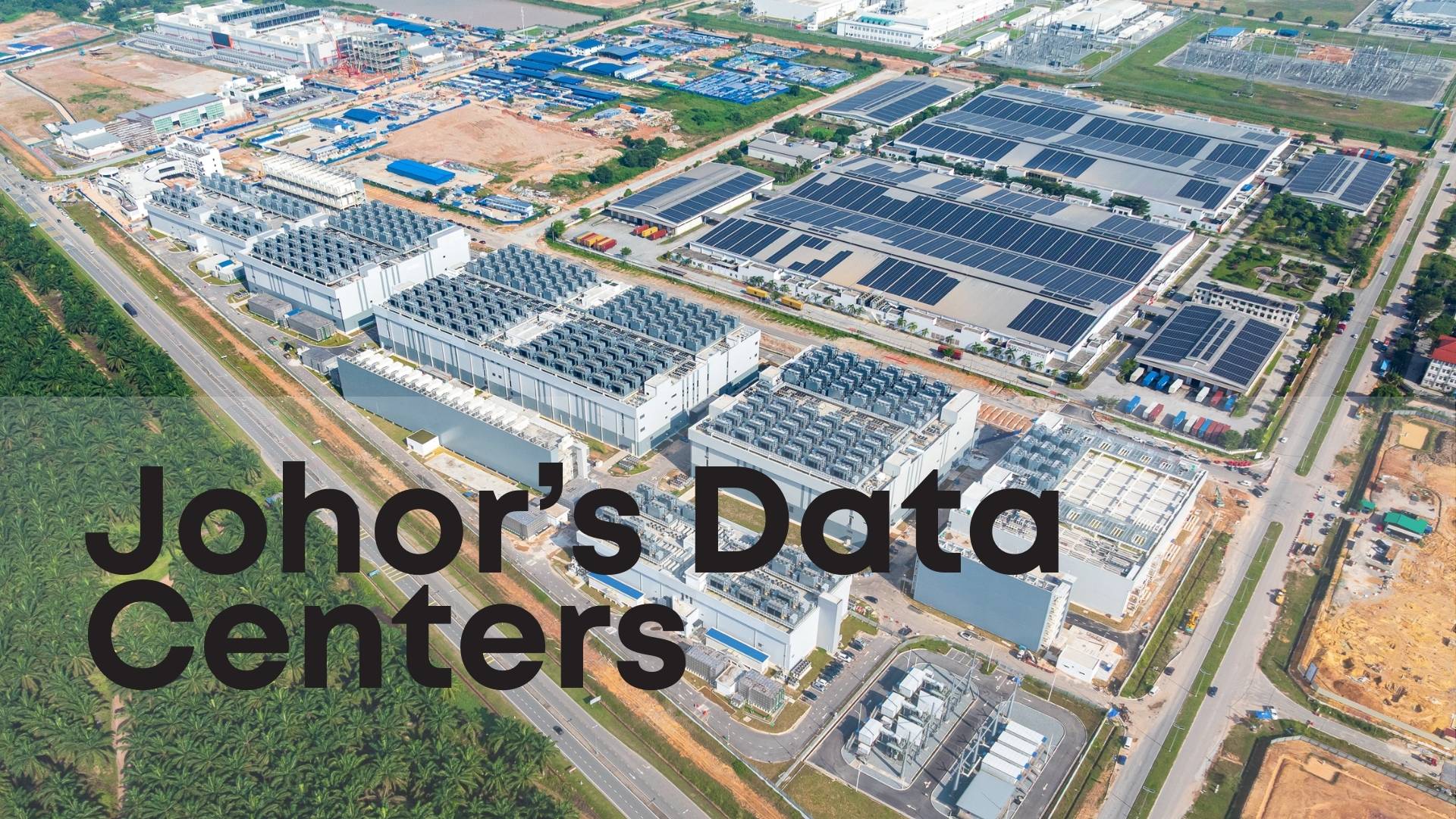
Image from Star Property.
Johor is in the middle of a data centre boom with 42 approved projects with investment commitment of RM164.45 billion. Operational capacity is ~370 MW with pipeline projects pushing toward several gigawatts.
The growth for data centers is demand-driven: AI, cloud, digital services, and edge computing fuel data centre capacity expansion and an effect of the temporary moratorium for Singapore’s DC.
For the first time, a building becomes an ecosystem, not just infrastructure. A data centre is no longer a warehouse of servers; it’s an AI factory.
This positioned Malaysia as one of the faster movers during the last decade.
Malaysia is not the earliest but a “second-mover”; hence gives the advantage and ability to adopt more modern infrastructure, better cooling, efficiency standards and policies rather than being burdened by legacy systems.
Major DC hubs like Northern Virginia in the USA and Singapore regulate growth to balance resource use. A lot of lessons learned here.
Since become a hotspot for DC investment, yet the Johor data centre infrastructure challenges were the highlights recently. This article explores why power and water are critical, how policies matter, and the facilities management role.
Why it matters:
Data centres consume massive electricity and water. Cooling alone accounts for 30–50%of total energy usage. Critical concerns for Johor data centre infrastructure where pipelines and treatment capacity are already under strain.
Johor Data Centre Infrastructure: Current State
- Johor’s NRW: Johor claims the best water supply in Malaysia with 20%-24% NRW while national average is at 37% NRW
- Operational data centres: 12, ~370 MW capacity (Dec 2024)
- Pipeline/committed projects: ~898 MW, with aggregated supply including under-construction projects reaching ~2.6 GW by Q4 2025
- Water security: Historical interruptions in Johor are linked to asset reliability and pollution. Recent state announcements promise system upgrades, but short-term risk remains.
- Energy allocation mismatch: Government briefings indicate approved power capacity often exceeds actual usage, highlighting underutilised investment in energy infrastructure.
The takeaway: Johor has the land, investment attractions, and connectivity to be a leading hub but water and energy reliability are bottlenecks.
To understand what Johor needs, let’s first look at how mature hubs handle these challenges.
Global Context: How they do it?
1. Northern Virginia, USA
- Operational capacity: ~7 GW
- Features: hyperscale hubs, highly resilient power grids, fibre-rich
- Policy approach: market-driven innovation, some state incentives, emphasis on energy efficiency and renewable sourcing
2. Singapore
- Operational capacity: ~approximately 1 GW as of early 2025. It is one of the highest density markets with land constraint
- Approach: government regulates approvals based on PUE (Power Usage Effectiveness)/WUE (Water Usage Effectiveness), carbon tax, and land allocation constraints
- Water reuse and desalination increasingly required for cooling
3. Europe (Frankfurt, Amsterdam, London)
- Operational capacity: ~9.4 GW
- Policy: mandatory efficiency reporting, renewable energy quotas, industrial heat reuse encouraged
- Constraint: land and grid limitations push operators to innovate
4. China
- Policy-driven expansion: government clusters data centres, enforces energy quotas, mandates efficiency metrics
- Trend: combining cooling innovation with regional planning to reduce grid stress
Observation:
Johor is behind these mature hubs in regulatory sophistication and resource management, but it can learn from their approaches before the next wave of data centre growth. Having worked with data centre facilities in the past (10–15 years ago where CRAC and in-row coolings were the norms), I’ve witnessed dramatic improvements in cooling efficiency.” It will be great to bind requirements into the development order.
Cooling & Resource Efficiency Metrics
- PUE: Ideal <1.3; typical in APAC hubs ~1.2–1.5
- WUE: Emerging metric; Singapore mandates efficiency reporting
- Cooling needs: ~0.5–1 MW of power load per MW of IT can be required for cooling (varies with tech)
- Trends: Modern data centres use immersion cooling, adiabatic cooling, or air-side economisers to cut water dependency by 40–70% compared to older evaporative systems
Policy Gap in Malaysia
- Water efficiency (WUE)
- Voluntary energy efficiency reporting
- Heat reuse is not widely incentivised; regulatory oversight on actual energy use is limited
- Phased energy allocation, performance-linked approval, mandatory reporting similar to Singapore and EU
Malaysia’s Infrastructure Planning
Recent government data (November 2025) shows Malaysian data centres consuming only 47% of allocated capacity, sparking concerns about waste. But this perhaps misreads how infrastructure works.
In Malaysia, developers must reserve power based on Maximum Demand (MD) projections during planning. Data centres scaling takes 18–36 months. Building for peak demand from day one avoids costly grid upgrades mid-operation.
The perceived “over-allocation” isn’t a design flaw but a feature in Malaysia’s infrastructure development. It prioritises future readiness over short-term efficiency metrics.
But Johor are in the advantageous position to learn from more matured hubs.
The global standard: The USA bakes capacity reservation into utility contracts. While Singapore ties approvals to phased consumption and PUE targets hence scaling with accountability. China enforces efficiency thresholds before granting additional quotas.
The opportunity: Malaysia’s method is reserves capacity but lacks the performance monitoring that mature markets use to ensure reservation becomes utilisation. We need Singapore’s accountability without losing our planning flexibility.
Takeaways
- DC are not power hungry. DCs need infrastructure coherence. Power, water, and policy working as one system. They face multiple bottlenecks, infrastructure, resources, and policy intent, each dependent on the others.
- Resource planning matters: Align water supply improvements and energy allocation with pipeline projects.
- Learn from global hubs: Implement efficiency-linked approvals and monitoring before scaling too fast.
- Innovate in cooling: Bind efficiency requirements into equipment standards to the Development Order (DO) so that companies invest in water-efficient or water-free cooling technologies.
- FM as strategic partner: FM teams must become the bridge between IT operations, sustainability, and local resource security. The high standard of DC will be a catalyst for FM.
- Johor has a once-in-a-generation opportunity but needs to avoid making the same mistakes Singapore made in 2010 with better policy and lessons from more mature hubs.
- Johor data centre infrastructure stands at a crossroads. The next 5 years will define the DC hubs in Johor if learned lessons are implemented and with proper executions, or maybe playing catch ups.
FAQ
Johor’s data centre boom is fueled by multiple factors: the rise of cloud computing, increased demand for AI and machine learning workloads, and the expansion of digital services like e-commerce, fintech, and streaming platforms. Its strategic location near Singapore, combined with available land, fiber connectivity, and government support, makes it a preferred hub for regional and global operators.
How much water do data centres consume for cooling?
Cooling is a major component of data centre operations, accounting for 30–50% of total energy usage. Water-intensive cooling systems, such as evaporative cooling towers, require significant water volumes per MW of IT load. While exact consumption varies by facility design and efficiency measures, modern techniques like adiabatic cooling, closed-loop chilled water, and immersion cooling can reduce water use by 40–70% compared to traditional systems.
What is Johor’s NRW rate and why does it matter for data centres?
Johor has one of the lowest Non-Revenue Water (NRW) rates in Malaysia, around 24–25%, compared to the national average of 37.1%. (parlimen.gov.my)
NRW represents water lost before reaching users due to leaks, theft, or metering errors. High NRW limits the effective water available for high-demand users like data centres. Johor’s relatively low NRW makes it more resilient to large-scale cooling demands, but careful planning is still essential to avoid stressing local resources.
How does Johor compare to other global data centre hubs?
Globally, data centre hubs manage resource efficiency differently. Johor is emerging but lags in regulatory sophistication and mandatory efficiency standards, though its NRW performance and location give it a competitive advantage if sustainable practices are adopted.
What role does facilities management play in supporting Johor’s data centre growth?
Facilities management (FM) is central to ensuring operational resilience, efficiency, and sustainability. FM teams oversee:
1- Optimising PUE/WUE, deploying advanced cooling technologies.
2- Monitoring supply, planning for NRW impacts, maintaining redundancy.
3- Preventing downtime and improving asset lifecycle.
4- ESG reporting: Demonstrating sustainable operations to regulators and investors.